
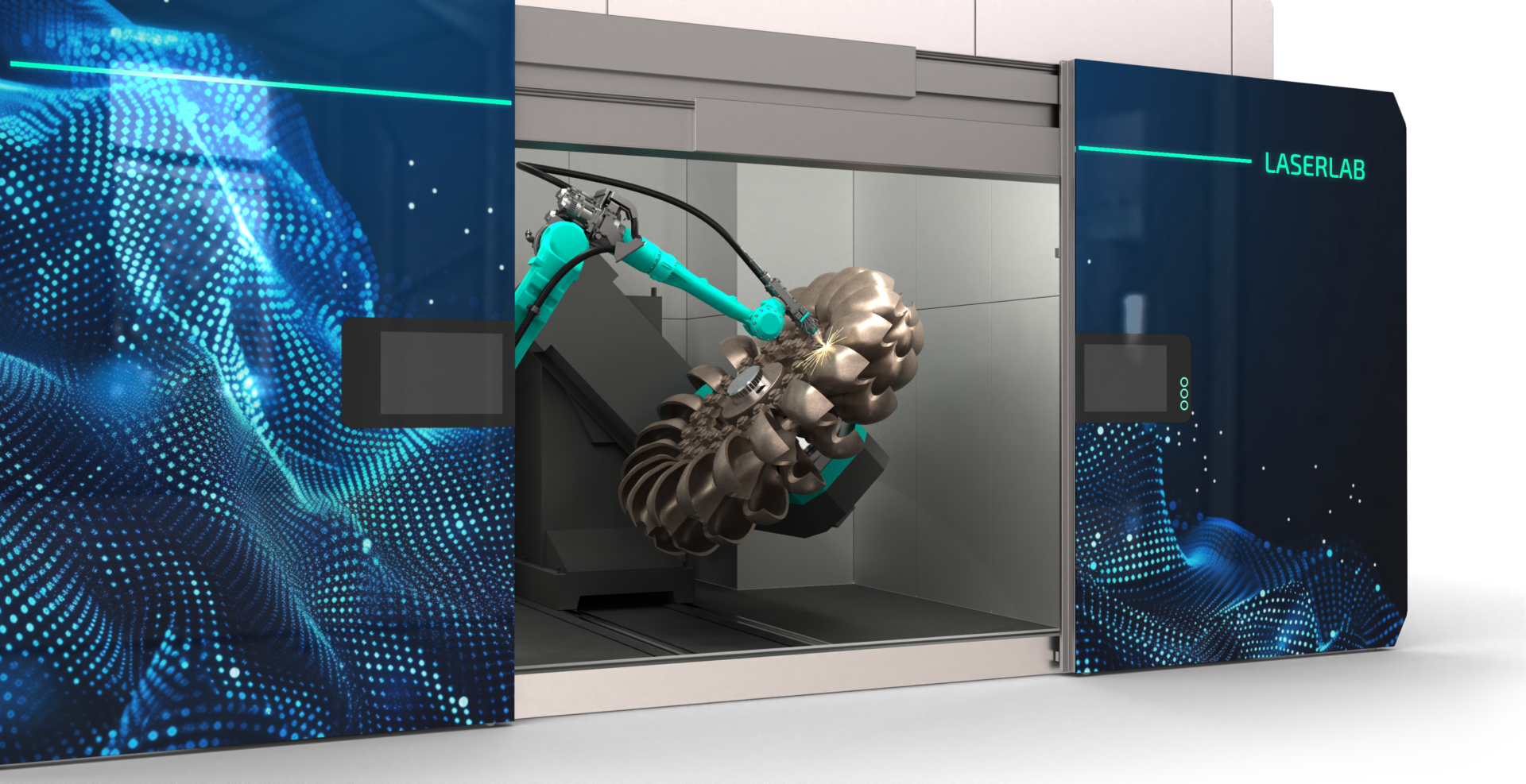
Turn legacy repair into autonomous, traceable, high-precision operations.
ART combines laser + robot + no-code programming to make repair-welding autonomous—repeatable, controllable, and ready to scale.
THE OPPORTUNITY
The market of life extension for high-performance and high-value assets is growing.
Replacing critical components has become increasingly:
- costly,
- time-consuming,
- supply-chain dependent,
- and environmentally inefficient.
At the same time, traditional repair approaches are reaching structural limits.
But the repair solutions used today are constrained by two fundamental factors:
- They require extensive pre- and post-processing, which lengthens the process chain and increases costs.
This leads to longer downtimes, process complexity, and makes reproducibility more difficult. - The processes are heavily dependent on scarce skilled workers.
This dependency causes bottlenecks in availability and scalability.
The Result:
- Many companies still buy new instead of repairing and refurbishing equipment.
- Others cannot scale circular business models due to resource constraints.
- Service organizations struggle to industrialize repair without increasing headcount.
This is not a technology problem.
It is a system problem.
THE SOLUTION
To overcome these limitations, industrial repair must transition from manual, skill-dependent processes to autonomous, data-driven systems.
ART enables this transition by integrating:
- laser-based surface treatment,
- industrial robotics,
- 3D scanning and sensing,
- and no-code software
into a fully integrated, autonomous repair platform.
Damaged components are digitally captured, repair paths are generated automatically, and material is restored with high precision — without reliance on individual craftsmanship.
ART transforms industrial repair by:
- Reducing downtime through shorter, simplified process chains
- Lowering repair costs by eliminating manual work and redundant steps
- Replacing tribal knowledge with data-driven consistency, enabling repeatable quality
- Enabling scalable circular business models through automation
- Reducing material use, energy consumption, and emissions at a global scale
ART does not merely improve existing repair processes.
It redefines how high-value assets are maintained, extended, and monetized.
THE PRODUCT
The core product is the Autonomous Repair Technology (ART) system —
a turnkey platform for high-precision, autonomous repair and life extension.
- Laser surface treatment technology
for high-precision and -performance additive manufacturing processes. - Industrial robots
for precise and adaptive path guidance in manufacturing processes. - Vision and sensor packages
or real-time data acquisition, model analysis, and monitoring. - No-code programming software
for autonomous and self-learning manufacturing operations. - Laser safety systems
for various automation levels and manufacturing environments.
THE MARKETS
The problem described particularly affects companies from:
- Prioritized markets: Hydropower , Oil & Gas, Mining & Earthmoving
- Secondary markets: Forging & Tooling, Recycling, Cement, Agriculture, etc.
and components such as:
- Turbines, Pumps and Valves
- Crushers, Cones, Screens and Wear Plates
- Compressors, Generators and other Rotating Equipment
- Rolls, Hammers and Shredders
- as well as Tubes, Pipes, Elbows, Conveyors, Mills, Blades and many more…
we focus on the following regions:
- Prioritized regions: Alpine Region, Nordic Region and North America.
- Secondary regions: Australia, South America, Middle East and MENA Region.
WHY NOW
Across asset-intensive industries, repair volumes are increasing while the capacity to execute them manually is declining. Skilled labor constraints, aging asset bases, ESG pressure, and volatile supply chains are no longer cyclical effects — they are becoming permanent boundary conditions. At the same time, advances in robotics, sensing, software, and laser-based processes have reached a level of maturity where autonomous repair is no longer experimental, but industrially viable.
What has been missing is not technology, but a system that integrates these capabilities into a scalable, repeatable, and economically compelling model. ART closes this gap.
For industrial groups, this creates a narrowing window: those who establish autonomous repair capabilities early will shape standards, ecosystems, and customer expectations.
In this context, inaction is not neutral. It implicitly delegates category leadership to others.
Autonomous Repair Technology is not positioned as a disruptive replacement of existing industrial capabilities.
It is designed as a strategic extension — connecting proven surface, material, and process expertise with autonomous, software-driven service models that define the next phase of industrial value creation.
As these models mature, the boundary between product, service, and digital capability continues to blur. In such an environment, autonomous repair evolves from a complementary technology into a structural element of how industrial value is created, defended, and scaled.
The relevant strategic question, therefore, is not whether autonomous repair will become part of the industrial landscape — but where it should reside in relation to existing core businesses.